
PAS 79-1: What Makes a Strong Fire Risk Assessment
What separates a strong PAS 79-1 fire risk assessment from a weak one? Practical guidance on report quality, common pitfalls, and what enforcing authorities expect.
What is PAS 79-1:2020?
PAS 79-1:2020 is a BSI-published Publicly Available Specification (PAS) that sets out a recognised methodology for carrying out and documenting fire risk assessments for non-housing premises in England and Wales. It provides a structured methodology aligned with the five-step approach from the UK Government’s fire safety guidance, operating under the Regulatory Reform (Fire Safety) Order 2005.
It applies to all commercial, industrial, educational, healthcare, and public premises. Housing falls under a separate standard, BS 9792:2025. If you are assessing a block of flats or any other residential building, PAS 79-1 is not the correct standard to follow.
PAS 79-1 is not legislation, but it is the methodology that fire and rescue authorities, courts, and professional bodies expect to see applied. Working to it demonstrates that your approach meets a recognised, peer-reviewed framework. The question is not whether you follow PAS 79-1, but how well you apply it.
What does a strong PAS 79-1 assessment look like?
The standard gives you a structure. What it cannot give you is the professional judgment to apply that structure well. That is what separates a report that genuinely protects people from one that simply exists on file.
A strong PAS 79-1 assessment starts with specificity. Every observation should be tied to a location within the premises, describe exactly what was found, and explain why it matters in terms of fire risk. A finding that reads “fire door on the second-floor east corridor serving the open-plan office has a damaged intumescent strip and the self-closer is not pulling the door fully into the frame” gives the responsible person something they can act on. A finding that reads “some fire doors require attention” gives them nothing.
This applies across every section of the pro forma, from electrical hazards through to means of escape, fire detection, and management arrangements. The assessor’s role is not simply to record whether something is present or absent. It is to evaluate whether what is in place is adequate for the specific premises, its use, and its occupants. A fire alarm system might be present and operational, but if it provides only manual call point coverage in a building with sleeping risk, recording it as satisfactory would be a serious misjudgment.
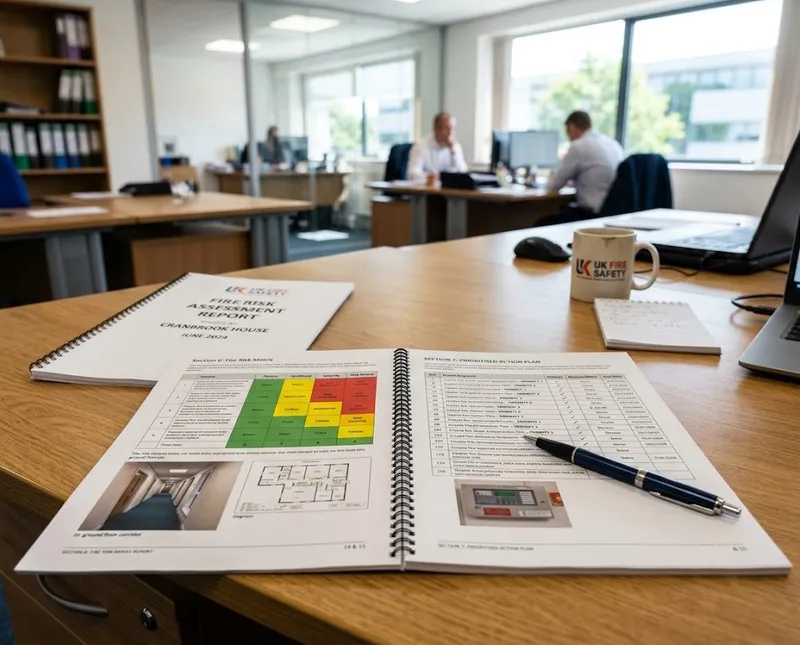
The action plan is where the assessment earns its value. Each recommendation should describe the specific issue, state the required action, assign a realistic priority, and set a timescale that reflects the level of risk. Priorities need to mean something. If everything is marked as medium priority with a vague “within three months” timescale, the responsible person has no way to distinguish between a fire door that will not latch and a missing sign in a low-traffic corridor. A well-structured action plan typically uses four levels: immediate (24 to 48 hours), high (one to four weeks), medium (one to three months), and longer-term (three to six months), with the most critical life-safety issues clearly separated from lower-priority maintenance items.
The risk evaluation at the end of the report should reflect the assessor’s genuine professional opinion, not a default setting. A risk matrix that considers likelihood of fire against potential consequences is the standard approach, producing a risk level from trivial through to intolerable. But the risk level must be justified by the findings. If the assessment has identified significant shortcomings in means of escape or fire detection, a conclusion of “tolerable” risk needs to be explained, because an enforcing authority will certainly ask.
Where do PAS 79-1 reports most commonly fall short?
The most frequent problem is generic content. Reports where the observations could apply to almost any building, because the assessor has recycled template text rather than recording what they actually found on site. Responsible persons and enforcing authorities can tell the difference, and so can any competent assessor reviewing the work.
Vague findings are closely related. Statements like “housekeeping could be improved” or “the means of escape arrangements are generally satisfactory” do not meet the standard expected of a professional assessment. PAS 79-1 asks for relevant information including a description of arrangements and deficiencies observed. That means specific descriptions, specific locations, and a clear indication of what needs to change.
Weak action plans are another common issue. Some reports list dozens of recommendations without meaningful prioritisation, making it impossible for the responsible person to know where to start. Others assign priorities that do not match the severity of the finding, either downplaying serious risks or inflating minor ones. The action plan is the part of the report that drives real-world outcomes. If it is not clear, specific, and properly prioritised, the assessment has not fulfilled its purpose.
Scope and limitations are sometimes treated as boilerplate when they should be tailored to the specific assessment. A fire risk assessment under PAS 79-1 is non-destructive and non-invasive, based on visual observation and information provided by the responsible person. Hidden voids, concealed construction, and untested systems fall outside the scope unless the assessor has been specifically instructed otherwise. But the limitations section should also note any areas of the premises that could not be accessed, any information that was requested but not provided, and any assumptions that were made. If the responsible person does not understand the boundaries of what was assessed, they cannot make informed decisions about whether further investigation is needed.
Finally, some reports lack the assessor’s own professional voice. PAS 79-1 is built on the principle that fire risk assessment requires trained judgment. A report that reads like a machine-generated checklist, with no evidence of the assessor’s reasoning or interpretation, does not reflect that principle. The significant findings section in particular should demonstrate that a competent professional has weighed the evidence and reached a considered view, not simply catalogued what was seen.
What do enforcing authorities expect from a PAS 79-1 report?
When a fire and rescue authority officer reviews a fire risk assessment, they are looking for evidence that a competent person has carried out a thorough evaluation and that the responsible person has a clear picture of the fire risks in their premises.
They will check whether the assessment is current and has been reviewed at appropriate intervals. They will look at whether the findings are specific to the premises rather than generic. They will examine the action plan to see whether recommendations have been prioritised sensibly and whether the responsible person has acted on them. They will consider whether the overall risk evaluation is consistent with the findings.
An assessment that is clearly tailored to the premises, demonstrates professional judgment, and produces a practical action plan is unlikely to attract further scrutiny. One that reads as a template, contains vague or contradictory findings, or fails to address obvious hazards will prompt questions, and potentially enforcement action, not because the report format was wrong, but because the standard of assessment was not suitable and sufficient.
How does PAS 79-1 relate to BS 9792?
PAS 79 was split in 2020 into PAS 79-1 (non-housing) and PAS 79-2 (housing). PAS 79-2 was withdrawn in August 2021 and has since been superseded by BS 9792:2025, a full British Standard with a nine-step methodology designed specifically for residential premises.
Assessors working across both sectors need to be familiar with both standards. The methodology, checklist structure, and report expectations differ. Applying PAS 79-1 to a block of flats would not produce a suitable and sufficient assessment for that building. Using the correct standard is a fundamental part of demonstrating competence.
Frequently Asked Questions
Is PAS 79-1 a legal requirement?
PAS 79-1 is not legislation. The legal duty comes from the Regulatory Reform (Fire Safety) Order 2005, which requires a suitable and sufficient fire risk assessment. PAS 79-1 provides the methodology that is widely accepted as meeting that standard for non-housing premises.
Do you have to record a PAS 79-1 fire risk assessment?
Yes. Since 1 October 2023, Section 156 of the Building Safety Act 2022 has required the responsible person to record the fire risk assessment in full, not just the significant findings, and the previous exemption for premises with fewer than five employees has been removed. A complete PAS 79-1 report, retained alongside its earlier versions, is the clearest way to meet that duty.
What is the difference between PAS 79-1 and BS 9999?
PAS 79-1 is a standard for carrying out fire risk assessments. BS 9999 is a code of practice for the design, management, and use of buildings, covering fire safety engineering principles. They serve different purposes but complement each other: BS 9999 may inform the design standards an assessor references when evaluating a building, while PAS 79-1 provides the framework for the assessment itself.
How often should a PAS 79-1 assessment be reviewed?
There is no fixed statutory interval, but annual review is widely recommended as good practice. The assessment should also be reviewed whenever there are significant changes to the premises, its use, or its fire precautions, or when there is reason to believe the findings are no longer valid.
FireRecord supports both PAS 79-1 and BS 9792 assessments, with separate checklists, section structures, and report templates aligned to each standard. Find out more at firerecord.co.uk.
Related Articles
Fire Risk Assessment Example: What a Good Report Contains
A section by section look at a completed UK fire risk assessment: premises details, hazards, risk rating, significant findings and the action plan.

Fire Risk Assessment Software: What Actually Matters
Every building is different. The right software writes each report to match.

Fire Risk Assessment Audit Trail: What the Trail of Records Must Show
What a fire risk assessor's audit trail must capture, why excluded questions need written reasons, and how a report is amended after sign-off.