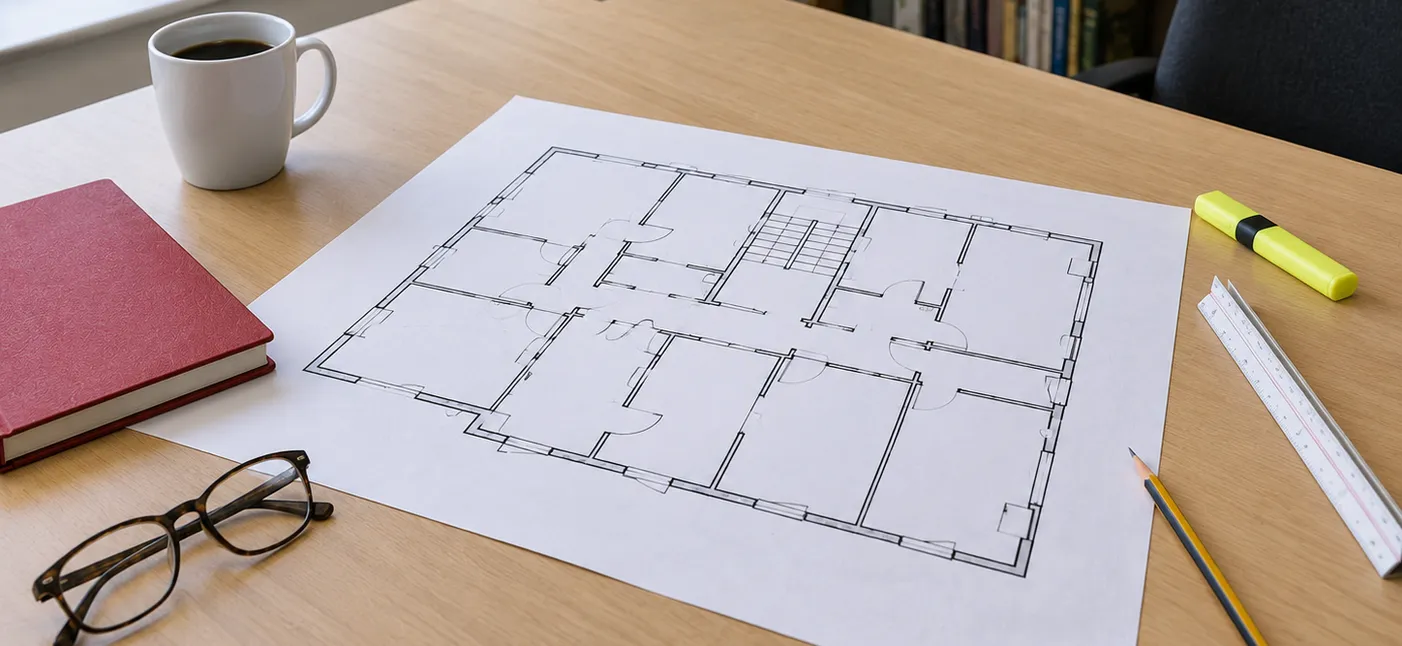
What Is a Fire Risk Assessment? UK Requirements Explained
A clear guide to fire risk assessments in the UK: who needs one, what the law requires, the five-step process, and how often to review. Written for assessors and responsible persons.
What is a fire risk assessment?
A fire risk assessment is a structured evaluation of a building’s fire hazards, the people at risk, and the fire safety measures in place to protect them. Its purpose is to identify shortcomings in fire precautions and produce a clear action plan to reduce risk to an acceptable level.
Under Article 9 of the Regulatory Reform (Fire Safety) Order 2005 (commonly called the RRO or Fire Safety Order), the responsible person for any non-domestic premises in England and Wales must ensure a suitable and sufficient fire risk assessment is carried out. This is not optional. It is a legal duty, and failing to comply can result in enforcement action, fines, or imprisonment.
The assessment covers everything from sources of ignition and fuel, to escape routes, fire detection systems, emergency lighting, signage, staff training, and the overall management of fire safety. The output is a written report documenting the findings, the level of risk, and a prioritised action plan.
Is a fire risk assessment a legal requirement in the UK?
Yes. In England and Wales, the Regulatory Reform (Fire Safety) Order 2005 requires a fire risk assessment for virtually all non-domestic premises. This includes offices, shops, factories, warehouses, pubs, restaurants, schools, care homes, hospitals, hotels, and the common parts of blocks of flats.
The only premises excluded under Article 6 of the Order are domestic premises occupied as a single private dwelling. If you live in a house or a self-contained flat with no shared communal areas, the Order does not apply to your home. But the moment a building has shared corridors, stairwells, or communal spaces, a fire risk assessment is required for those areas.
Scotland and Northern Ireland have their own fire safety legislation (the Fire (Scotland) Act 2005 and the Fire and Rescue Services (Northern Ireland) Order 2006 respectively), but the core principle is the same: if people use a building for work or other non-domestic purposes, a fire risk assessment must be in place.
Non-compliance carries serious consequences. Local fire and rescue authorities have powers to inspect premises, issue enforcement notices, and prosecute. Penalties under the Fire Safety Order can include unlimited fines and, in the most serious cases, up to two years in prison.
Who is the responsible person?
The responsible person is the individual or organisation with ultimate accountability for fire safety in a premises. Article 3 of the Fire Safety Order defines this as:
- The employer, if the premises is a workplace
- The person who has control of the premises, such as an occupier or managing agent
- The owner, where the person in control does not have full responsibility for maintenance and safety
In practice, this often means the building owner, landlord, employer, or facilities manager. In blocks of flats, the responsible person is typically the freeholder, management company, or local authority housing department.
Where multiple duty holders share responsibility for parts of a building, Article 22 of the Order requires them to cooperate and coordinate with each other. This is common in multi-tenanted commercial buildings and mixed-use developments.
The responsible person does not have to carry out the fire risk assessment personally, but they remain legally accountable for ensuring it is suitable and sufficient, even if they commission someone else to do it.
What does a fire risk assessment involve?
The UK Government’s fire safety guidance sets out a five-step approach, which aligns with the methodology used in PAS 79-1:2020 for commercial premises:
Step 1: Identify fire hazards. The assessor examines the premises for sources of ignition (electrical equipment, heating systems, cooking appliances, smoking materials), sources of fuel (paper, textiles, flammable liquids, waste accumulation), and sources of oxygen that could feed a fire.
Step 2: Identify people at risk. This includes everyone who may be in or around the building: employees, visitors, customers, residents, contractors, and anyone else who could be affected. Special attention is given to people who may need additional assistance in an evacuation, such as disabled persons, young children, elderly occupants, or lone workers in remote areas.
Step 3: Evaluate, remove, or reduce the risks. The assessor evaluates whether existing fire precautions are adequate. This covers means of escape, fire detection and alarm systems, emergency lighting, firefighting equipment, signage, compartmentation, and fire doors. Where shortcomings are found, recommendations are made.
Step 4: Record, plan, and train. The assessment must be recorded in full. Since 1 October 2023, Section 156 of the Building Safety Act 2022 has required every responsible person to record the whole fire risk assessment and the fire safety arrangements, whatever the size of the premises. The old threshold of five or more employees no longer applies. An action plan is produced with prioritised remedial measures, and appropriate fire safety training must be provided to staff.
Step 5: Review. The assessment is a living document. It must be kept under regular review and updated whenever there is reason to believe it may no longer be valid.
Who can carry out a fire risk assessment?
The Fire Safety Order requires that the assessment be carried out by a “competent person” but does not mandate any specific qualification or accreditation, and there is no single universally recognised credential.
In practice, this means competence should never be taken lightly. A fire risk assessment requires the ability to identify hazards that are not always obvious, to understand how fire behaves in different building types, and to evaluate whether existing precautions are genuinely adequate. These are specialist skills. A responsible person without formal fire safety training is unlikely to have the knowledge needed to produce an assessment that is truly suitable and sufficient, even for premises that appear straightforward. Buildings that seem simple on the surface can present risks that only a trained eye would recognise.
In practice, professional fire risk assessors typically hold qualifications from bodies such as the Institution of Fire Engineers (IFE), NEBOSH, or BAFE (the body that administers the SP205 fire risk assessment competency scheme). Membership of a professional register or third-party certification scheme provides additional assurance of competence, though it is not a legal requirement.
BS 9792:2025 sets out a detailed framework for what competence looks like, including understanding of fire safety legislation, fire development, building construction, evacuation strategies, and the specific hazards associated with different premises types. BS 8674:2025, published in January 2025, sets out a framework for the competence of individual fire risk assessors, with three levels, foundation, intermediate and advanced, matched to the complexity of the buildings being assessed.
How often should a fire risk assessment be reviewed?
There is no fixed legal interval for review, but the general consensus across industry guidance is that fire risk assessments should be reviewed at least annually. PAS 79-1:2020 and BS 9792:2025 both recommend regular review, and most professional assessors advise a 12-month cycle as standard practice.
Beyond the annual review, the assessment should also be revisited whenever:
- Structural or material alterations are made to the building
- There is a change in the use or activities carried out on the premises
- A significant change in staffing, ownership, or occupancy occurs
- Fire precautions are modified or upgraded
- There is a fire, near miss, or other incident
- Relevant legislation changes
The key principle is that the fire risk assessment must remain valid and reflective of current conditions. If anything changes that could introduce new hazards or affect existing fire precautions, a review is needed regardless of when the last one was carried out.
What standards apply to fire risk assessments?
Two main standards govern how fire risk assessments are conducted in the UK:
PAS 79-1:2020 covers fire risk assessments for premises other than housing. This includes commercial, industrial, healthcare, educational, and all other non-residential buildings. It uses a five-step methodology aligned with the Government’s fire safety guidance and is the standard most commonly referenced by assessors working on commercial premises.
BS 9792:2025 covers fire risk assessments for housing, including purpose-built blocks of flats, houses in multiple occupation (HMOs), sheltered housing, and supported housing. Published in 2025, it supersedes the earlier PAS 79-2:2020 (which was itself withdrawn in August 2021). BS 9792 introduces a more detailed nine-step methodology and incorporates requirements for Person-Centred Fire Risk Assessments (PCFRAs) and compliance with the Fire Safety (England) Regulations 2022.
Both standards operate under the overarching framework of the Regulatory Reform (Fire Safety) Order 2005, with additional requirements introduced by the Fire Safety Act 2021 and the Building Safety Act 2022.
In England, the Fire Safety (Residential Evacuation Plans) (England) Regulations 2025 add a further duty from 6 April 2026. In residential buildings over 18 metres or seven storeys, and in buildings over 11 metres with a simultaneous evacuation strategy, the responsible person must offer a person-centred fire risk assessment and an emergency evacuation plan to any resident who could not evacuate without help.
Frequently Asked Questions
Does every building need a fire risk assessment?
Every non-domestic premises in England and Wales requires a fire risk assessment under the Fire Safety Order. This includes workplaces, commercial buildings, and the common parts of residential blocks. The only exemption is a domestic premises occupied as a single private dwelling.
Can I do my own fire risk assessment?
The Fire Safety Order does not mandate a specific qualification, but that does not mean anyone can produce a suitable and sufficient assessment. A fire risk assessor has specialist skills, including knowledge of fire behaviour, building construction, means of escape, and fire protection systems. A responsible person without this training is unlikely to identify all the hazards present, and the consequences of getting it wrong can be severe. The strong recommendation is to always use a competent, experienced fire risk assessor. The responsible person remains legally accountable for the assessment being suitable and sufficient, regardless of who carries it out.
What happens if I do not have a fire risk assessment?
The local fire and rescue authority can inspect your premises at any time. If they find no fire risk assessment in place, or find it to be inadequate, they can issue enforcement notices, prohibition notices (which can close your premises), or prosecute. Penalties include unlimited fines and up to two years’ imprisonment.
How much does a fire risk assessment cost?
Costs vary depending on the size, complexity, and use of the premises. A straightforward assessment of a small office or shop might cost a few hundred pounds. Larger or more complex buildings, such as hospitals, schools, or high-rise residential blocks, will cost significantly more. It is worth comparing quotes from BAFE-registered assessors to ensure you are getting a competent, quality service.
FireRecord is a UK-built fire risk assessment app designed around PAS 79-1 and BS 9792. It helps assessors capture evidence on site, generate structured reports, and manage the full assessment workflow from a single tool. Find out more at firerecord.co.uk.
Related Articles

Do Holiday Lets and Airbnbs Need a Fire Risk Assessment?
Yes. In England and Wales the Fire Safety Order applies the moment a guest pays to stay, even for one night, and the assessment must be written down.
Who Can Carry Out a Fire Risk Assessment?
The law requires a competent person, and the responsible person carries the risk, so here is what competence means and how to check an assessor has it.
How Often Should a Fire Risk Assessment Be Reviewed?
Twelve months is the standard interval for reviewing a fire risk assessment, and here is what forces an earlier one, and when a review is not enough.