
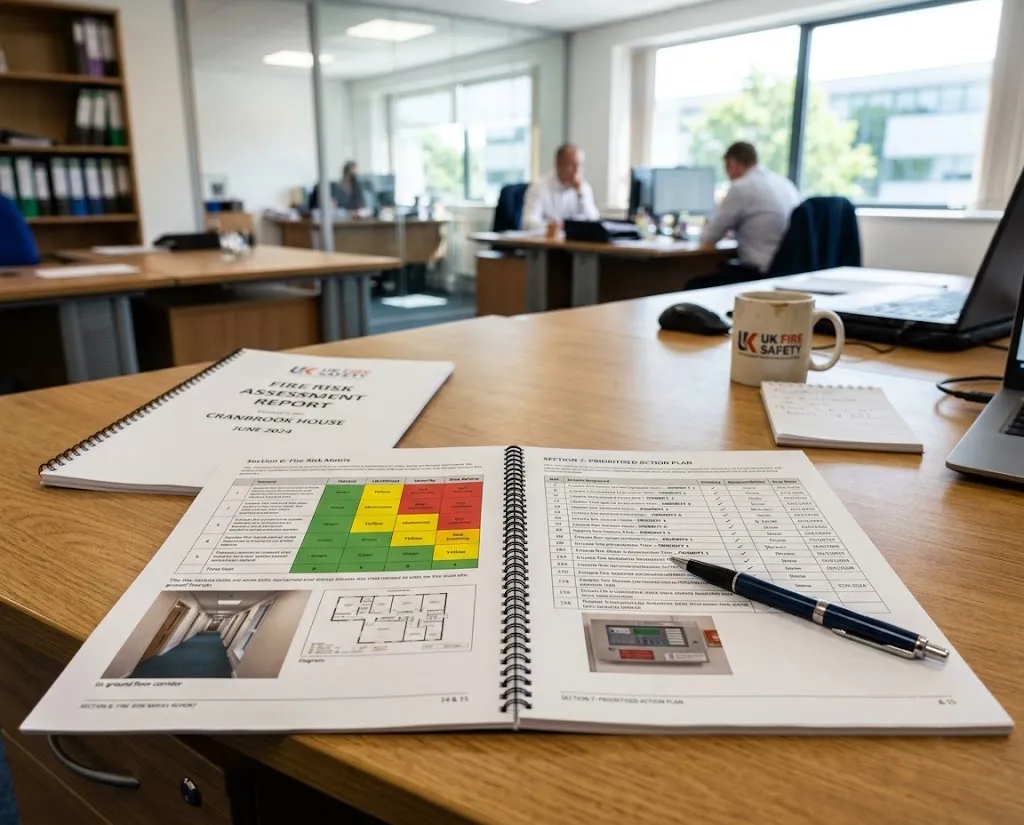
Fire Risk Assessment Example: What a Good Report Contains
A section by section look at a completed UK fire risk assessment: premises details, hazards, risk rating, significant findings and the action plan.
What does a completed fire risk assessment look like?
A completed fire risk assessment is a structured report, not a filled-in form. A professional example produced to PAS 79-1:2020 for a commercial premises typically runs to somewhere between fifteen and forty pages and contains six recognisable parts: the premises particulars, an executive summary with an overall fire risk rating, the assessment itself, the significant findings, a prioritised action plan, and the supporting information such as photographs and plans.
People search for a sample fire risk assessment for a good reason. The legislation describes a duty, not a document, so the fastest way to understand what suitable and sufficient means in practice is to look at what a competent assessor actually produces. This article walks through that structure section by section, using the kind of content a real report would contain.
What appears in each section of the report?
Premises particulars. The address, the use of the building, its construction and number of storeys, the occupancy, and whether anyone sleeps there. This section also records who the responsible person is, with a UK contact address, and who carried out the assessment, all of which must now appear in the record by law.
Fire hazards. Sources of ignition, fuel and oxygen, recorded specifically. A strong example reads like observation, not category: portable heaters in use in a ground-floor office adjacent to stored packaging, a multi-gang extension lead daisy-chained under desk four, waste cardboard accumulating by the rear exit. A weak example reads: electrical equipment, combustible materials, no further detail.
People at risk. Who is in the building and when, with attention to anyone at heightened risk: lone workers, night staff, visitors unfamiliar with the layout, and anyone who would need assistance to evacuate.
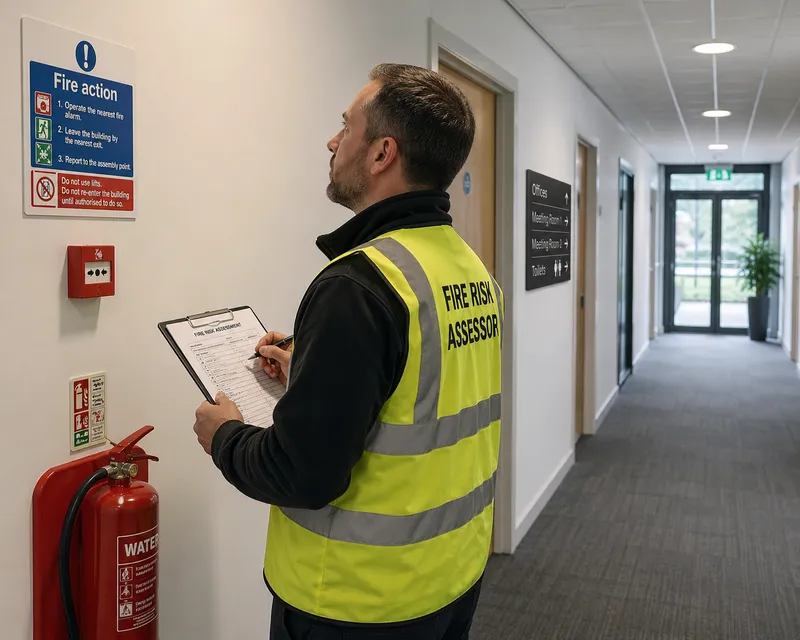
Means of escape and fire protection. The escape routes and whether they are adequate, protected and unobstructed; fire detection and alarm provision; emergency lighting; signage; extinguishers; and compartmentation, including the condition of fire doors.
Management of fire safety. Training, fire drills, maintenance and testing records, housekeeping, and the arrangements for keeping all of it under review. Assessors give this section real weight because a well-equipped building with no management is not a safe building.
How is the fire risk rating presented?
Most professional reports present an overall fire risk level using the risk-level estimator described in PAS 79-1:2020, which combines the likelihood of fire with the likely consequence for life safety. The output is one of five levels: trivial, tolerable, moderate, substantial or intolerable. The rating gives the reader an immediate answer to the question the whole document exists to address: how serious is the fire risk in this building, and how urgently does something need to happen?
The rating only means something when the report shows how it was reached. A moderate rating supported by specific findings and a costed, dated action plan is credible. A tolerable rating sitting on top of generic text is the kind of thing enforcing officers read past in seconds. If you want to understand what sits behind a defensible rating, we covered the methodology in our article on PAS 79-1.
What separates a strong action plan from a weak one?
The action plan is the most read section of any fire risk assessment, and in a good example every entry has four properties: it is specific, it is prioritised, it has an owner, and it has a timescale. Compare two versions of the same finding. Weak: fire doors require attention. Strong: replace the damaged intumescent strip and re-hang the ill-fitting fire door to the first-floor plant room, high priority, building manager, within one month.
Strong plans also distinguish between hazards to eliminate now, such as the daisy-chained extension leads, and improvements to programme, such as upgrading detection coverage. When each completed action is dated and evidenced, the plan becomes part of the audit trail that protects the responsible person if an enforcing authority ever asks what was done and when.
What are the signs of a weak fire risk assessment example?
Weak examples share a set of recognisable markers, and they are worth knowing whether you are commissioning an assessment or reviewing one:
- Generic template text that could describe any building in the country
- Not applicable entered against sections that plainly apply
- No photographs and no plans, so nothing can be verified against the building
- An overall rating with no visible reasoning behind it
- An action plan with no priorities, owners or timescales
- No assessor name, no date, and no review date
A completed example is only useful as a model of structure and quality. The content must come from the building in front of the assessor. Copying findings from a sample assessment into your own record produces a document, not an assessment, and the difference is exactly what an enforcing authority is trained to detect.
Frequently Asked Questions
Where can I download a completed fire risk assessment example?
There is no official government library of completed examples. The gov.uk sector guides show what an assessment should consider for each premises type, and some fire and rescue services publish illustrative material, but most complete worked examples online come from commercial providers and vary in quality. Judge any example against the structure described above.
How long is a typical fire risk assessment report?
It depends on the size and complexity of the premises. A small, simple workplace might be covered properly in ten to fifteen pages, while a large or multi-occupied building can run far longer. Length is not quality: what matters is that the assessment is specific to the building and records the full assessment, as the law has required since October 2023.
What are the five fire risk levels?
PAS 79-1:2020 describes a widely used five-level scale: trivial, tolerable, moderate, substantial and intolerable. The level combines how likely a fire is with how severe the consequences for the people in the building would be, and it drives the urgency of the action plan.
Can I copy an example assessment for my own building?
No. An example shows you the structure and standard to aim for, but the Regulatory Reform (Fire Safety) Order 2005 requires an assessment of your premises, carried out by someone competent to judge the risks in that building. Findings transplanted from a sample document will not survive contact with an inspection.
FireRecord produces structured fire risk assessment reports aligned with PAS 79-1:2020 and BS 9792:2025, with findings, photographs and action plans captured on site and a complete record of every version. Find out more at firerecord.co.uk.
Related Articles

PAS 79-1: What Makes a Strong Fire Risk Assessment
What separates a strong PAS 79-1 fire risk assessment from a weak one? Practical guidance on report quality, common pitfalls, and what enforcing authorities expect.
What Is a Fire Risk Assessment? UK Requirements Explained
A clear guide to fire risk assessments in the UK: who needs one, what the law requires, the five-step process, and how often to review. Written for assessors and responsible persons.

BS 9792:2025: What Changed from PAS 79-2 and Why It Matters
BS 9792:2025 replaced PAS 79-2 for housing fire risk assessments. What changed, what the nine-step methodology means in practice, and how assessors should adapt.