Do Holiday Lets and Airbnbs Need a Fire Risk Assessment?
Yes. In England and Wales the Fire Safety Order applies the moment a guest pays to stay, even for one night, and the assessment must be written down.
Do holiday lets and Airbnbs need a fire risk assessment?
Yes. In England and Wales the Regulatory Reform (Fire Safety) Order 2005 applies to any premises where someone pays to stay and the premises are not occupied as a private dwelling, and the government’s own guidance adds “even if it is just for one night”. A cottage, a flat, a chalet, a shepherd’s hut or a room in your own home let to paying guests is covered. Since 1 October 2023 the assessment must be recorded in full, whatever the size of the property. The person who must make sure it is done is the responsible person: the owner, or the agent or management company that controls the property. In Scotland the duty comes from the Fire (Scotland) Act 2005, and every host must also hold a short-term let licence.
Which properties count?
The Order excludes “domestic premises”, which it defines as premises occupied as a private dwelling. A holiday let is not occupied as a private dwelling while paying guests are in it, so the exclusion does not help. The government guide lists the factors an enforcing fire and rescue authority will look at: how long guests stay, and whether they are friends or family who share your social life or strangers who booked online. Short stays by paying strangers put the property firmly inside the Order.
That covers more than cottages. The guide applies the Order to caravans, glamping pods, shepherd’s huts and yurts alike, and to a room let in the home you live in where the guest is a paying stranger on a short stay. The measures differ, because a fire door makes no sense in a yurt, but the duty to assess the risk does not.
Where a holiday flat sits in a block, two assessments meet. The building’s responsible person assesses the common parts, the structure and the front doors that open onto them. You assess the inside of your flat, and the guide expects you to explain the block’s evacuation strategy to guests who may never have met a stay-put policy.
What must the assessment cover in a self-catering property?
The government guide is written for small premises: a single property on the ground floor or ground and first floor, sleeping up to ten guests, with no more than four bedrooms on the first floor, or an individual flat. Anything larger, higher or with a more complex layout is outside that guide and needs a fuller assessment. Within its scope, the measures the guide expects are specific:
- Detection. Interlinked smoke and heat alarms, mains powered with a tamper-proof battery backup (Grade D1), in hallways, stairs, living rooms and bedrooms, with a heat alarm in the kitchen. Sealed battery alarms may be accepted as a short-term measure until a mains system is fitted.
- Escape. A protected route from the bedrooms to the outside, which in a two-storey cottage means the hall and stairs kept clear and the doors opening onto them able to hold back fire. Exit doors must open from the inside without a key.
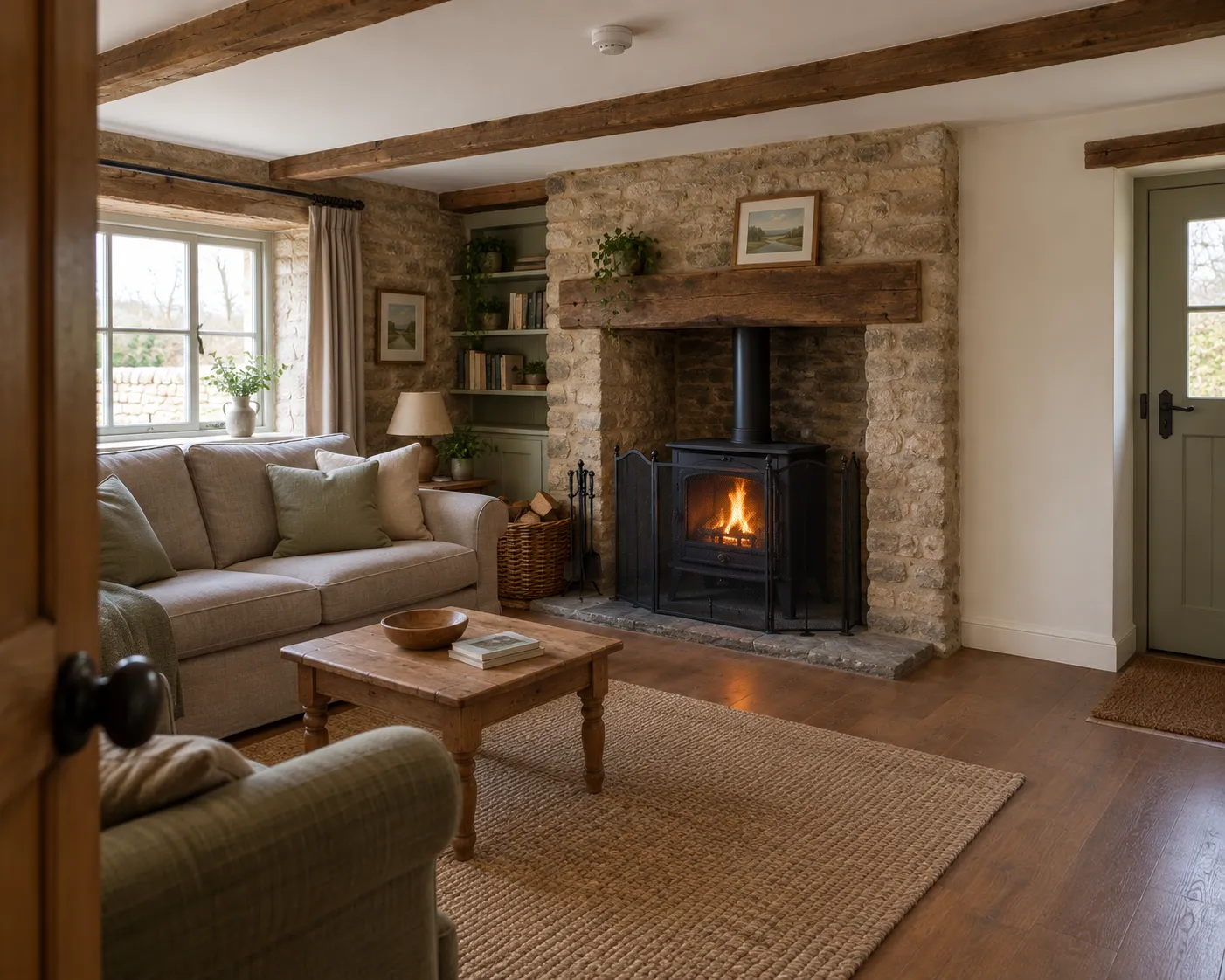
- Cooking and heating. Gas appliances serviced every year by a Gas Safe registered engineer, cut-off devices on the pipework from any outside LPG supply, and for open fires and log burners a fire guard, an annual chimney sweep and a carbon monoxide detector.
- Contents. Furniture and furnishings that comply with the Furniture and Furnishings (Fire) (Safety) Regulations 1988, no candles, tea lights or ethanol burners supplied to guests, and a policy that guests may not use their own.
- Information. A fire action notice with the property’s full address and postcode, so a guest who has never been there before can direct the fire service.
- Maintenance. Alarms tested every month and at every changeover, fire doors checked every six months, and the assessment itself reviewed every twelve months.
Who should carry out the assessment?
A competent fire risk assessor. The guide includes a template, and it is a useful way to understand what the assessor will look for, but the judgements that matter in a holiday let are exactly the ones an owner is least placed to make: whether an upstairs bedroom is a dead end if the kitchen catches fire, whether a converted barn’s stair will hold smoke back, whether a listed cottage’s doors can be upgraded. Guests will be asleep, in an unfamiliar building, possibly after a drink. A professional assessor sees the building as a stranger does, and their report gives the owner a written basis for every decision, which is what the fire and rescue authority will ask for.
What do assessors find most often in holiday lets?
- Battery smoke alarms that do not talk to each other, so a fire in the lounge does not wake anyone upstairs.
- A kitchen at the foot of the only staircase, with no fire door between them.
- Bedrooms reached only through another room.
- Exit doors with keyed locks and the key kept “somewhere safe”.
- Candles left as a welcome gift.
- Log burners with no guard, no carbon monoxide alarm and no record of a sweep.
- Second-hand sofas and mattresses with no fire label.
- Hot tubs and outdoor heaters added after the last assessment, with nothing updated.
- A fire action notice with the owner’s home address rather than the property’s.
None of these is expensive to put right, and every one of them puts guests at serious risk while it stays that way.
What are the new registration schemes, and do they replace the assessment?
They do not. Registration tells the authorities that a property exists. The fire risk assessment is the law that already applies to it.
- England. On 3 September 2026 the government told Parliament that the national short-term let register will be fully operational by March 2027. The detail is still being finalised, but the scheme is expected to be mandatory, with each property registered before it is advertised, and the fire safety duties are unchanged.
- Wales. Registration with the Welsh Revenue Authority opens in October 2026, and every provider of overnight stays must be registered by 31 March 2027. A licensing scheme for self-catering accommodation is planned under a Bill announced in November 2025, with a standard covering gas and electrical certificates, insurance, and smoke and carbon monoxide alarms.
- Scotland. New short-term lets have needed a licence from the council since October 2022, and every let has had to hold one since January 2025. The licence conditions cover fire and carbon monoxide detection, while the assessment itself is required by the Fire (Scotland) Act 2005. The application includes a fire safety checklist, and some councils ask for a copy of the assessment.
How often should a holiday let’s assessment be reviewed?
Every twelve months as standard, and sooner if anything changes: a new log burner or hot tub, a loft conversion, a change in the number of guests, new furniture, or any fire, however small. The review must be recorded like the assessment. A property that turns over guests every week changes faster than most workplaces, and the assessment should keep up.
Frequently Asked Questions
Does Airbnb check that I have a fire risk assessment?
No. Airbnb asks hosts to declare safety features such as smoke alarms and carbon monoxide alarms, and its terms require hosts to comply with local law, but it does not inspect properties or ask for the assessment. The fire and rescue authority enforces the Order, not the platform, and the responsibility is the host’s.
Can I write the assessment myself?
The safe answer is no. The law tests competence, and competence means training and experience in assessing fire risk, shown by certification or a professional register. Guests’ safety depends on judgements about escape routes that an owner has no training to make. Appoint a competent assessor, and use the government guide to understand the report and keep the property in the condition it describes.
Does a room in my own home need one if I host on Airbnb?
Usually, yes. The exclusion for private dwellings falls away when paying strangers stay on short bookings, and the guide says so. The measures will be lighter than for a whole cottage, but the assessment must still be carried out and recorded.
What about a glamping pod or a shepherd’s hut?
The Order applies. The guide says so by name, and notes that the usual measures are adapted to the structure rather than skipped. Detection, a clear way out, safe heating and cooking, and information for guests still apply.
What happens if I do not have one?
The fire and rescue authority can serve an enforcement or prohibition notice, which can close the let. Offences under the Order carry unlimited fines and, in the most serious cases, imprisonment. Insurers may also decline a claim after a fire where no assessment exists.
FireRecord is built for the assessor who visits a holiday let once a year and has to get every judgement down in writing. The report follows PAS 79-1:2020, the photos and findings are captured on site, and the Trail of Records keeps the reasoning behind every decision, so the owner can show the fire and rescue authority exactly what was assessed and why. Find out more at firerecord.co.uk.
Related Articles
Who Can Carry Out a Fire Risk Assessment?
The law requires a competent person, and the responsible person carries the risk, so here is what competence means and how to check an assessor has it.
How Often Should a Fire Risk Assessment Be Reviewed?
Twelve months is the standard interval for reviewing a fire risk assessment, and here is what forces an earlier one, and when a review is not enough.
What Is a Fire Risk Assessment? UK Requirements Explained
A clear guide to fire risk assessments in the UK: who needs one, what the law requires, the five-step process, and how often to review. Written for assessors and responsible persons.