Landlord Fire Risk Assessments: Which Properties Need One
When landlords in England need a fire risk assessment, what it must cover in HMOs and blocks of flats, and the duties that apply to every rented home.
Do landlords need a fire risk assessment?
It depends on the property. A landlord letting a house or flat to a single household does not need a fire risk assessment under fire safety legislation, because the Regulatory Reform (Fire Safety) Order 2005 does not apply to domestic premises. A landlord of a house in multiple occupation, or of a building containing two or more flats, does: the Fire Safety Order applies to the shared and common parts, and the landlord is usually the responsible person who must carry out and record a suitable and sufficient fire risk assessment.
That single distinction answers most of the confusion around landlord fire risk assessment templates. The template question only arises where the duty exists, and the duty follows the building type, not the fact of being a landlord.
Which fire safety law applies to which rented property?
A single let house or flat. The Fire Safety Order does not apply inside the dwelling. Fire safety is instead covered by the Housing Act 2004, under which the local council can assess fire as a hazard using the Housing Health and Safety Rating System, and by the Smoke and Carbon Monoxide Alarm (Amendment) Regulations 2022. Since 1 October 2022 those regulations have required at least one smoke alarm on every storey with a room used as living accommodation, a carbon monoxide alarm in any such room containing a fixed combustion appliance other than a gas cooker, and repair or replacement of alarms once a tenant reports a fault.
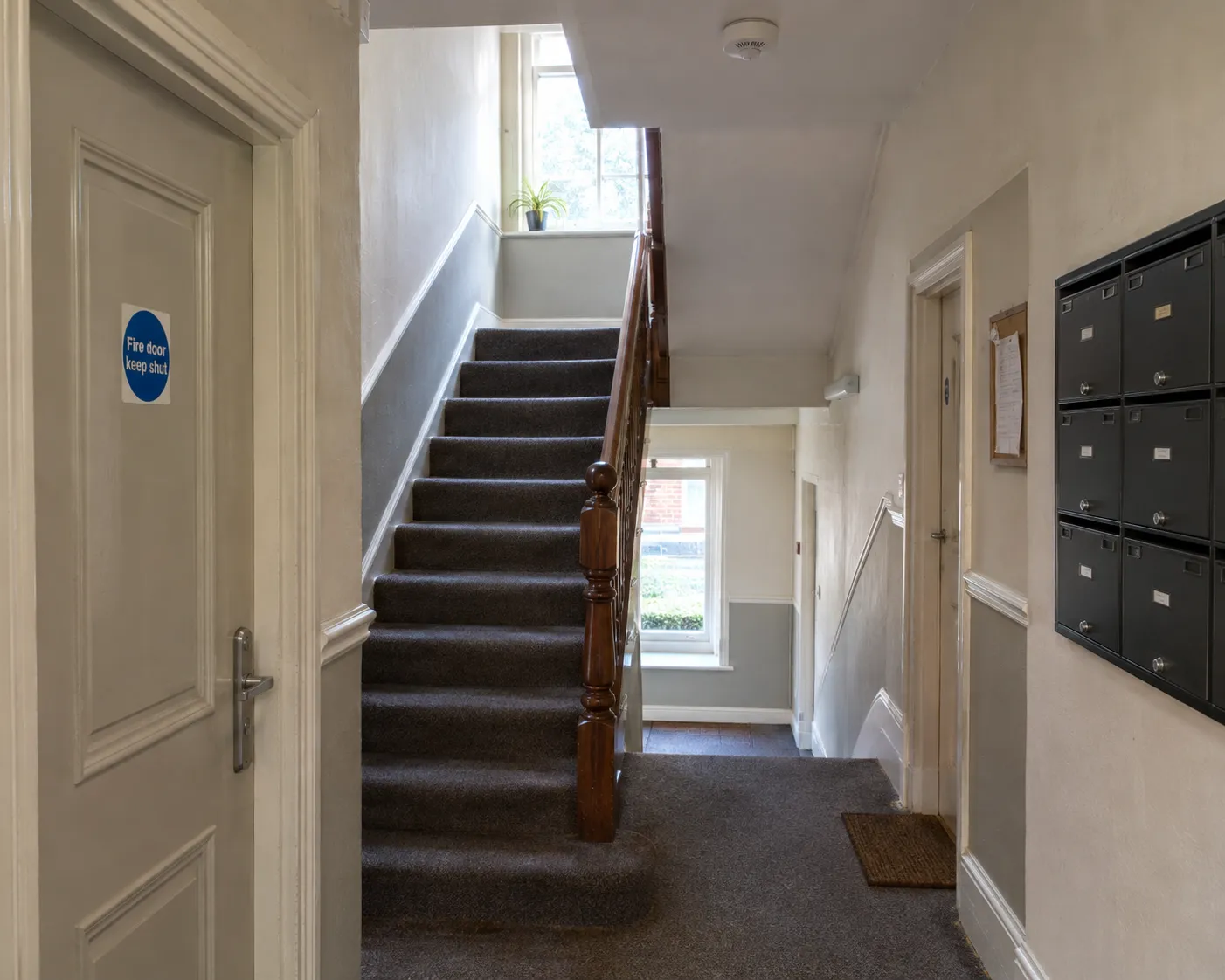
A house in multiple occupation. The shared parts of an HMO, such as hallways, staircases, shared kitchens and living rooms, fall under the Fire Safety Order, so a fire risk assessment of those areas is a legal requirement. Licensable HMOs, broadly those housing five or more people from two or more households, also carry fire safety conditions attached to the licence, enforced by the local housing authority.
A block of flats. The common parts require a fire risk assessment under the Fire Safety Order, and the Fire Safety Act 2021 put beyond doubt that the assessment must also cover the building’s structure, its external walls, including cladding, balconies and windows, and the entrance doors of individual flats. An assessment of a residential block that stops at the communal hallway is no longer capable of being suitable and sufficient.
What must a landlord fire risk assessment cover?
For an HMO or a block of flats, the assessment covers the same ground as any professional fire risk assessment, applied to a building where people sleep, which raises the stakes throughout. In practice that means the escape routes and whether they are protected and kept clear, fire doors including flat entrance doors, fire detection and alarm provision appropriate to the building, emergency lighting, the condition of external walls in scope since the Fire Safety Act 2021, arson risk and refuse storage, and the management arrangements: testing, maintenance, and the information given to residents.
Since 1 October 2023, Section 156 of the Building Safety Act 2022 has required the assessment to be recorded in full, whatever the size of the building. The recognised methodology for fire risk assessments in housing is now BS 9792:2025, which replaced PAS 79-2 and is written specifically for residential buildings, from converted houses to purpose-built blocks. We covered what changed in our article on BS 9792:2025.
What extra duties apply to blocks of flats?
The Fire Safety (England) Regulations 2022, in force since 23 January 2023, added recurring duties for multi-occupied residential buildings, and they scale with height.
In every building with two or more sets of domestic premises and common parts, the responsible person must give residents fire safety instructions, including how to report a fire and what to do if one starts, and information on the importance of fire doors. In buildings where any storey is more than 11 metres above ground level, fire doors in the common parts must be checked at least every three months, and reasonable efforts must be made to check every flat entrance door at least once a year. In high-rise buildings, those at least 18 metres tall or with seven or more storeys, further duties apply, including a secure information box, building plans and external wall information for the fire and rescue service, monthly checks of firefighting lifts and key equipment, and wayfinding signage.
From 6 April 2026 the Fire Safety (Residential Evacuation Plans) (England) Regulations 2025 add one more tier. In buildings at least 18 metres tall or with seven or more storeys, and in buildings over 11 metres with a simultaneous evacuation strategy, the responsible person must identify residents who could not evacuate without help, offer each of them a person-centred fire risk assessment, and keep a written evacuation plan for anyone who accepts. Those plans have to be reviewed, shared with the fire and rescue service in summary form, and kept current as residents move in and out.
Every one of those checks generates a record, and the records connect back to the fire risk assessment. A landlord who cannot evidence the quarterly door checks is exposed in exactly the way we described in our article on fire safety record keeping.
Can a landlord carry out the assessment themselves?
For a small, simple HMO, a landlord who understands fire safety can carry out their own assessment using the government guidance, and councils still widely refer to the LACORS fire safety guidance for existing housing. Self-assessment is lawful if the landlord is competent to judge the risks in that building, and the assessment must be recorded in full either way.
The honest threshold is low. Sleeping occupants, a single staircase, uncertain compartmentation in a converted building, or anything over two storeys are all reasons to commission a competent assessor working to BS 9792:2025. Where the Fire Safety Act 2021 brings external walls into scope, the judgement can require specialist input that no template or checklist can substitute for. The cost of a professional assessment is small against the liabilities: offences under the Fire Safety Order carry unlimited fines, and the people at risk are asleep in the building.
Frequently Asked Questions
Does a landlord need a fire risk assessment for a single rented house?
Not under the Fire Safety Order, which does not apply to a dwelling let to a single household. The landlord still has legal fire safety duties: working smoke alarms on every storey with living accommodation, carbon monoxide alarms where required, and a property free of serious fire hazards under the Housing Act 2004.
Is a fire risk assessment a legal requirement for an HMO?
Yes. The shared parts of an HMO fall under the Regulatory Reform (Fire Safety) Order 2005, so the responsible person, usually the landlord or managing agent, must carry out a fire risk assessment and record it in full. Licensable HMOs carry additional fire safety conditions enforced by the local housing authority.
How often should a landlord review a fire risk assessment?
The Fire Safety Order requires the assessment to be kept up to date and reviewed regularly, but sets no fixed interval. Established practice in residential buildings is to review at least annually, and immediately after a fire, building work, a change in occupancy or any other material change and, in taller buildings, whenever a resident’s evacuation plan changes.
Who enforces fire safety in rented housing?
Two regulators share the ground. The local fire and rescue authority enforces the Fire Safety Order in the common parts of HMOs and blocks of flats, while the local housing authority enforces housing standards inside dwellings under the Housing Act 2004, including HMO licence conditions.
Do the same rules apply in Scotland and Wales?
The duties are similar but the legislation differs. The Fire Safety Order covers England and Wales, while Scotland applies equivalent duties under Part 3 of the Fire (Scotland) Act 2005, and both nations set their own smoke and carbon monoxide alarm requirements for rented homes. Landlords with properties across borders should check each regime separately.
FireRecord supports BS 9792:2025 assessments for residential buildings, from HMOs to purpose-built blocks, with structured checklists, photographic evidence and a complete record of every assessment and action. Find out more at firerecord.co.uk.
Related Articles

Fire Risk Assessment Audit Trail: What the Trail of Records Must Show
What a fire risk assessor's audit trail must capture, why excluded questions need written reasons, and how a report is amended after sign-off.
Do Holiday Lets and Airbnbs Need a Fire Risk Assessment?
Yes. In England and Wales the Fire Safety Order applies the moment a guest pays to stay, even for one night, and the assessment must be written down.
Who Can Carry Out a Fire Risk Assessment?
The law requires a competent person, and the responsible person carries the risk, so here is what competence means and how to check an assessor has it.